
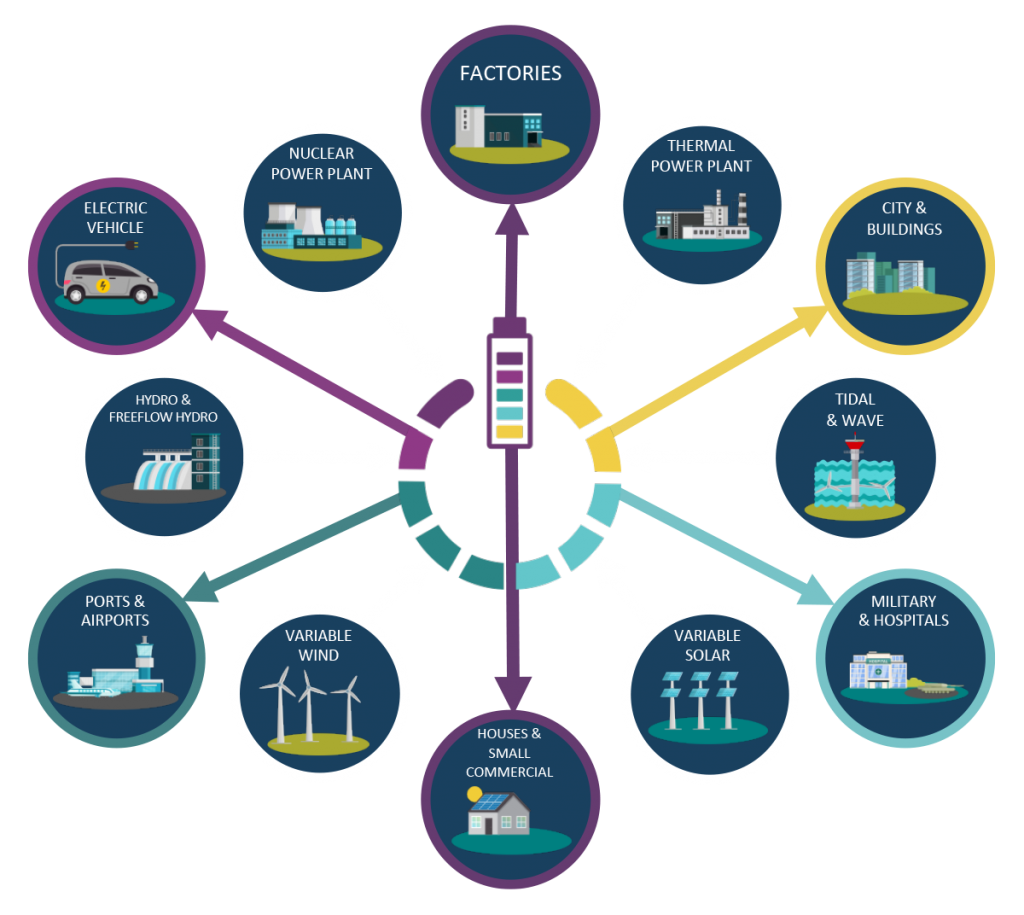
VRFBs located locally to power generators (i.e. wind turbines, solar PV, etc) will provide the following:
• Address any potential supply disruptions.
• Address variability of renewable resources across the grid.
• Maintain grid frequency.
• Eliminate the need to ‘dump’ surplus energy or stop generation.
The appropriately sized and scaled VRFBs will store energy directly from the generators when it is not required by the grid negating the need to ‘dump’ surplus energy or stop power generation. The digitally interconnected and controlled national network will communicate with the VRFB battery management system (BMS) such that stored energy can be called upon instantaneously to meet the demands of the consumer as-and-when required. The VRFB can ‘come in and out’ of the energy supply equation indefinitely with no degradation to the storage capacity or quality.
The VRFB can be configured as per generator requirements. REVOX23 equipment is fully scalable to fit any application either via bespoke design or multiple off-the shelf units and can be installed, fully containerised at any site in the UK, regardless of geography. REVOX23 equipment aims to guarantee reliability, quality, and security of supply 24 hours per day, 365 days per year.
VRFBs at Transmission & Distribution
VRFBs can be located strategically within the transmission and distribution network as required to provide the following:
• Defer transmission upgrades.
• Relieve transmission congestion.
• Provide grid ancillary services.
• Defer distribution upgrades.
• Provide back-up power during outages.
• Support smart micro-grids (or disconnection to ‘island mode’ if required).
• Reduce demand charges.
VRFB stations can be located specifically for transmission customers or scaled for city (districts and boroughs), towns, villages, or hamlets. Utilising smart technology, the area can automatically (or by prompt) switch between supply from the grid or from VRFB storage depending on multiple factors, but ultimately driven by time of use tariff (i.e. lowering energy bills).
VRFBs at Consumer (Industrial or Residential)
Consumers (industrial or residential) who have on-site renewable generation capacity (i.e. solar panels, wind turbine, etc) may install a small scale VRFB module effectively providing microgeneration and storage. This configuration will open up the possibility for consumers who produce their own energy to have control over exactly when they use their energy, when they store it or when they export it to the grid for profit. The opportunity is thus available to become an energy ‘prosumer’. This model will become more prevalent with the imminent roll out of electric vehicles in the UK as petrol and diesel cars are phased out. REVOX23 equipment can be scaled to residential level as required.
Levelized Cost
Two key metrics which are used to determine the viability and general project attractiveness are levelized cost of energy (LCOE) and levelized cost of storage (LCOS). The definitions of both are presented below:
Levelized Cost of Energy (LCOE): Represents the average revenue per unit of electricity generated that would be required to recover the costs of building and operating a generating plant during an assumed financial life and duty cycle. LCOE is often cited as a convenient summary measure of the overall competitiveness of different generating technologies.
Levelized Cost of Storage (LCOS): Represents the “all-in” cost to design, construct, and utilize the battery energy storage system over the course of its useful economic life cycle. This includes the fixed capital cost and variable O&M costs, effects of the battery technology’s degradation over time (i.e., decreased output, etc). When comparing a battery energy storage system against an alternative resource (e.g. flow batteries versus Li-Ion or lead acid), the LCOS is the preferred unit of measurement.
VRFBs can be adapted in a flexible and decentralised manner depending on the respective requirements and are fully scaleable from a few kW/kWh for domestic storage up to systems of several MW/MWh for grid storage. The different types of electrochemical energy storage systems have different physical/chemical properties, which affect the cost of the system. As such it is important to note that the cost of the storage system over its lifetime (levelized cost of storage – LCOS) is a critical factor used in selecting the most suitable system for a particular application. For example, the investment costs for lead-acid batteries are significantly lower than for all other technologies, but the service life is very short driving up the LCOS.
Technologies with similar investment costs at higher lifetimes result in a lower levelized cost of storage, however additional factors such as recycling, energy efficiency and maintenance costs have to be considered. A battery with a high efficiency, low recycling effort, low investment and maintenance costs and great freedom of scalability to meet the requirements of the application would be an ideal system and this is where the REVOX23 supplied VRFB comes into its own. REVOX23 believe that with the support of key international partners establishing and sourcing low cost vanadium, cutting edge membrane technology and optimum energy storage per unit volume of Vanadium electrolyte through improved chemistry and battery cell we can achieve a highly competitive and attractive LCOS